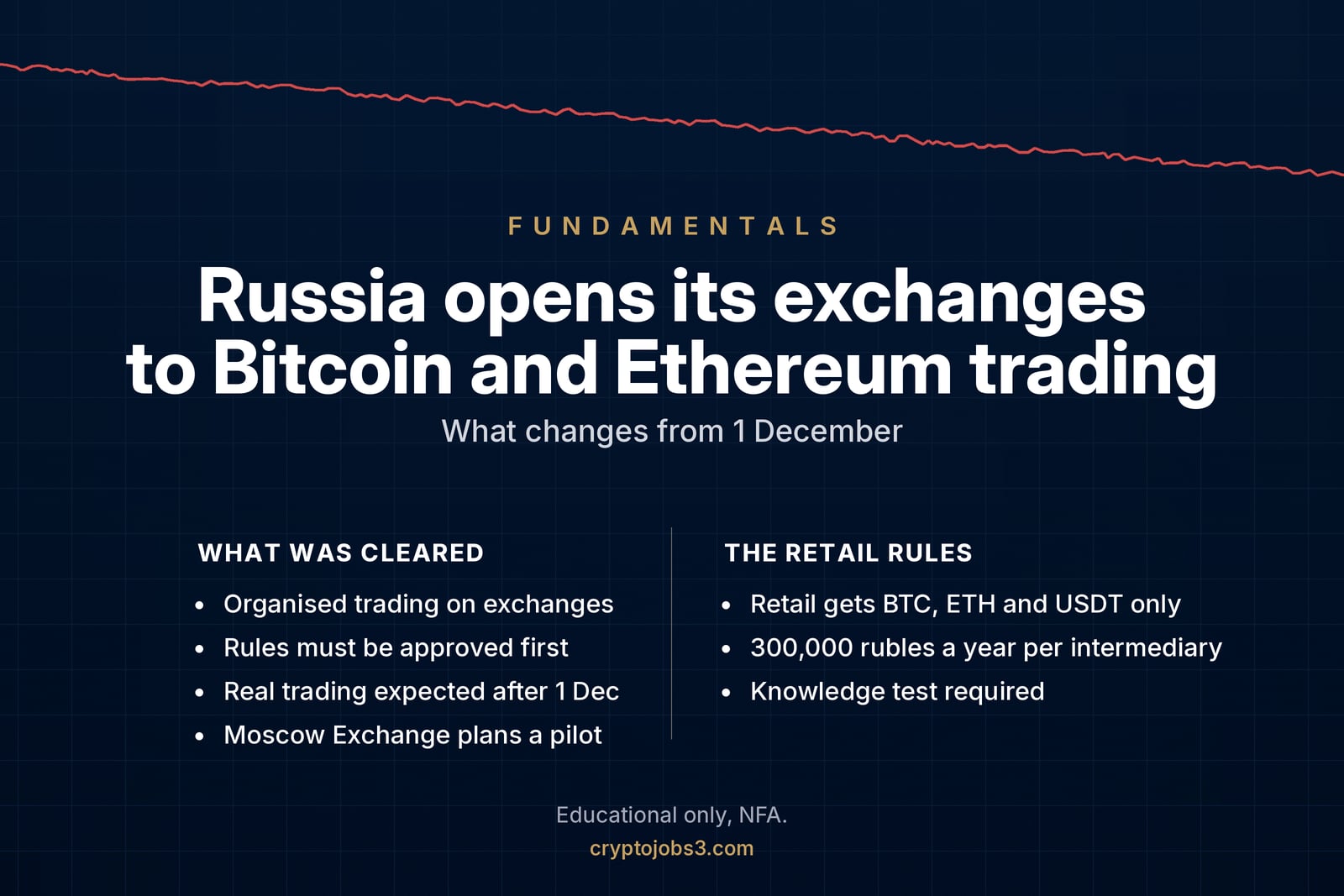
A Bank of Russia ordinance came into force on 22 November. Exchanges may now offer organised trading in digital currencies and digital rights, but only after the central bank approves each venue's trading rules. Real trading is expected after 1 December, and Moscow Exchange plans a pilot for Bitcoin, Ethereum and USDT around that date.
What changed
On 11 November the Bank of Russia said exchanges are authorised to begin cryptocurrency trading from 22 November, provided they obtain the regulator's agreement on their trading rules. The Ministry of Justice had registered the ordinance that sets those requirements.
TASS reported on 22 November that the ordinance is now in force. It also recalled earlier comments from the Bank of Russia that actual trading is expected to begin after 1 December.
The legal door is open. That is not the same as a market already running. No exchange can start until its rulebook has been approved.
The rules exchanges must follow
Exchanges must register the participants in crypto trading, including brokers, trust managers and central counterparties. They must keep registers of every order and every trade, and they must monitor activity.
For each cryptocurrency admitted to trading, the venue must calculate official price indicators: a current price, a weighted average price, a market price and a closing price. Exchanges must also report trading progress and results to the Bank of Russia, as they already do for other assets.
Why it matters for $BTC and $ETH
Russia is a G20 economy. Until now, much of its crypto activity sat in a grey zone or on offshore desks. This ordinance moves $BTC and $ETH onto a supervised exchange market, with registers, monitoring and official closing prices.
For ordinary investors, the first official list is Bitcoin, Ethereum and Tether's USDT. Bitcoin Magazine reported that this menu comes from a separate ordinance, published on 6 November and due to take effect on 17 November.
A regulated venue in a large economy can matter for how locals access $BTC and $ETH and how official prices are formed. It does not, by itself, create a new wave of global demand.
The limits (retail cap, sanctions, local channel)
Non qualified investors may buy Bitcoin, Ethereum and USDT only, up to 300,000 rubles a year per intermediary, through a broker, a trust manager or a registered crypto exchange office, on an exchange or over the counter. Qualified investors may access all cryptoassets, with no purchase cap. Both groups must still pass a knowledge test and read a risk disclosure before they can trade, Bitcoin Magazine reported.
The other constraint is sanctions. Bitcoin Magazine noted that United States sanctions already cover Moscow Exchange and its clearing house. Combined with the retail cap, the result is a local, supervised channel, not an instant opening of Russia to the world market.
What to watch after 1 December
Moscow Exchange said on 2 November that it plans to offer Bitcoin, Ethereum and USDT trades from 1 December, first as a pilot while participants connect. Trading would run on its existing stock market systems from 06:50 to 23:50 Moscow time (03:50 to 20:50 UTC), with the National Clearing Centre clearing the deals.
The exchange still needs the Bank of Russia to sign off on the trading rules. As of the 11 November reports, it had not said publicly whether that approval was already in hand. SPB Exchange has said it wants to start organised crypto trading by the end of the year, according to Bitcoin Magazine, citing Vedomosti.
Watch whether the Moscow Exchange pilot really starts after 1 December, and whether a retail cap of 300,000 rubles a year is high enough to bring local traders back from offshore platforms.
Educational only, NFA.