Long vs short: will the price go up, or down? Going long means you win if it rises. Going short means you win if it falls. Here is how each side makes or loses money, and why a short carries a special risk.
Key takeaways
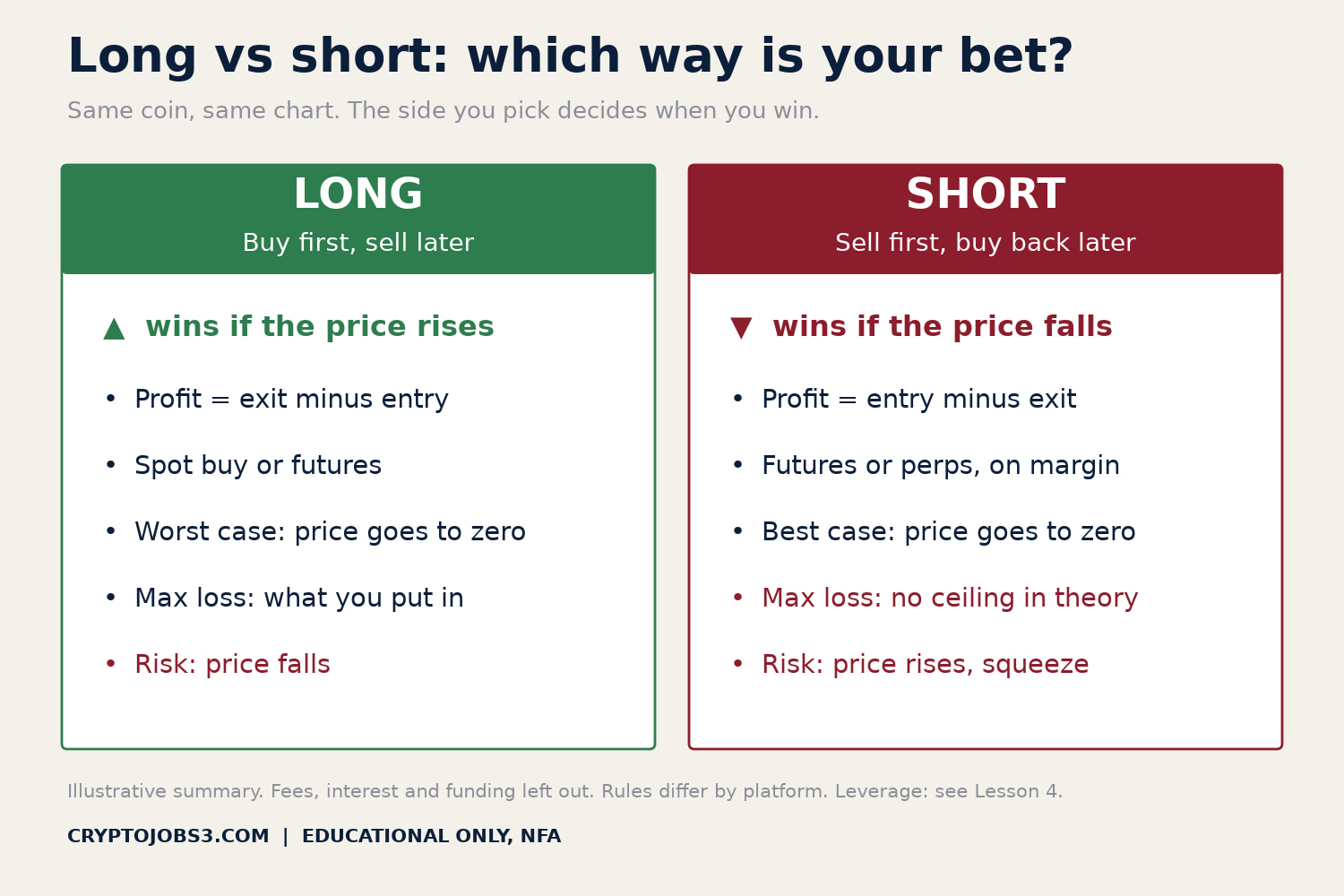
- Long means you buy first and sell later. You profit if the price goes up.
- Short means you sell first and buy back later. You profit if the price goes down.
- A long without borrowing can lose at most what you put in. A short's loss has no ceiling in theory.
- A simple spot buy is always a long. To go short in crypto, you need futures or perpetual futures.
What does going long mean?
You buy because you expect the price to rise. The Commodity Futures Trading Commission or CFTC, which oversees US futures markets, calls someone who expects higher prices a "bull".
Made-up example numbers, before fees. Bitcoin, or BTC, trades at $100,000. You buy 0.01 BTC for $1,000:
- BTC rises to $110,000. Profit: $100.
- BTC falls to $90,000. Loss: $100.
- Worst case, BTC goes to zero. You lose your $1,000, and nothing more.
What does going short mean?
You sell first and buy back later. If the price has dropped, you buy back cheaper and keep the difference. The CFTC calls someone who expects lower prices a "bear".
How can you sell what you do not own? An Investor.gov bulletin from the staff of the US Securities and Exchange Commission, the SEC, explains that your broker usually lends it to you, charges interest, and applies margin rules. Buying back to close a short is called covering.
Now a short worth 0.01 BTC at $100,000:
- BTC falls to $90,000. Profit: $100.
- BTC rises to $110,000. Loss: $100.
- Best case, BTC goes to zero. You gain $1,000, and that is the ceiling.
Why a short can lose more than you put in
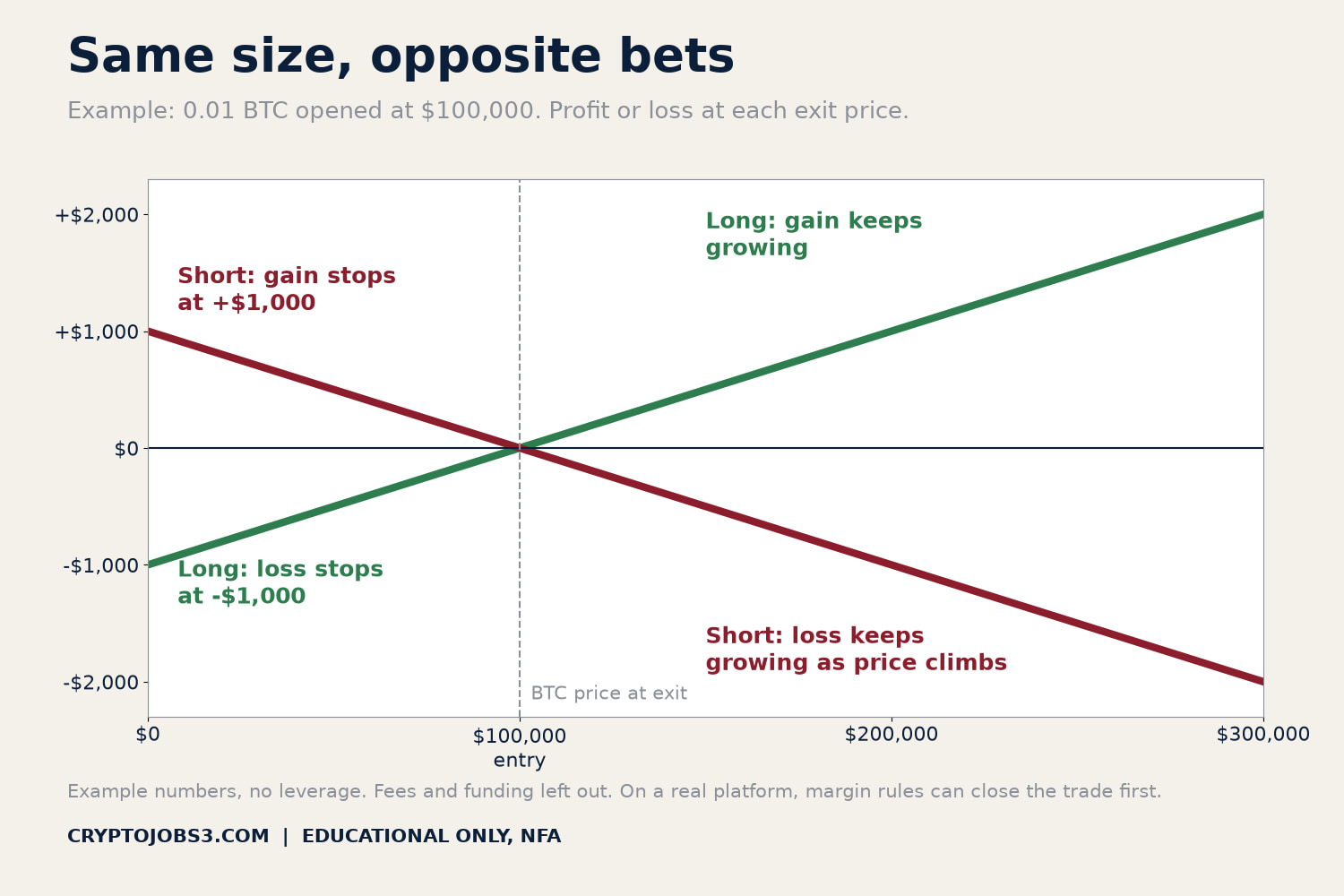
A long's loss stops at what you paid. A short has no such floor. If BTC triples to $300,000, the short above loses $2,000, twice the size of the trade. The SEC's staff warns that shorting leaves you open to unlimited losses, since a price can in theory keep rising forever. The bulletin covers stocks, but the logic holds for coins.
A short also sits on margin. The Financial Industry Regulatory Authority, known as FINRA, warns that in a margin account you can lose more than you deposit. For crypto futures, the CFTC adds that when prices move the wrong way, you top up your margin or close out, and can lose more than your starting deposit.
On small moves, the risk is similar both ways. On big moves, only the short's loss keeps growing.
How do you go long or short in crypto?
- Spot: you buy and own the coin. Always a long.
- Futures: a contract on the price. You buy one to go long, or sell one to go short.
- Perpetual futures, or perps: futures with no expiry date, which researchers describe as the most popular kind of crypto derivative. Funding payments between longs and shorts keep the price close to spot, see Lesson 7.
Where should a beginner start?
Start with longs on spot. Shorting is a normal tool, and some traders use it to protect coins they hold, but the CFTC says speculating in these markets should be seen as high risk.
Checklist before your first short
- Can you explain why you expect a fall?
- Do you know your margin and where liquidation sits? See Lesson 6.
- Do you understand funding on a perp? See Lesson 7.
- Are you using low leverage? Lesson 4 suggests 2x or 3x while you learn.
- Can you afford to lose this money?
FAQ
Can you lose more than you invest on a short?
Yes. A price has no ceiling in theory, and on margin, regulators warn that losses can go beyond your deposit.
Can you short crypto on spot?
Not with a simple spot buy, which is always a long. Traders use futures or perps.
Next lesson
Lesson 3: Market vs Limit Orders, and which one to use for your first trade.
Learn with the community
Get my market levels and the next lessons in one place. VIP is free when you join through a partner exchange (Affiliate), or available as a paid plan.
Sources
- CFTC Glossary: Long, Short, Bull, Bear, Cover
- CFTC Customer Advisory: Understand the Risks of Virtual Currency Trading
- Investor.gov, SEC staff: An Introduction to Short Sales
- FINRA: Margin Accounts
- CFTC staff: Request for Comment on Perpetual Style Derivatives
- He, Manela, Ross, von Wachter: Fundamentals of Perpetual Futures, arXiv
Educational only, NFA.