What Is Prop Trading? How Funded Trader Programs Work
Where prop trading comes from, how funded trader programs work, the main models, and the real risks to check before you pay.
You keep seeing the same promise: trade a big account, keep most of the profit, risk only a small fee. Part of it is true. Part of it is marketing. Prop trading is a real industry with a long history, and the version sold to retail traders online is a newer, looser copy of it. This guide explains the model in plain words: where it comes from, how it works, the main types, the risks, and why it fits crypto. Every term is explained on first use.
Key takeaways
Prop trading means trading a firm's own money, not clients' money. "Prop" is short for proprietary, which means "owned by the firm".
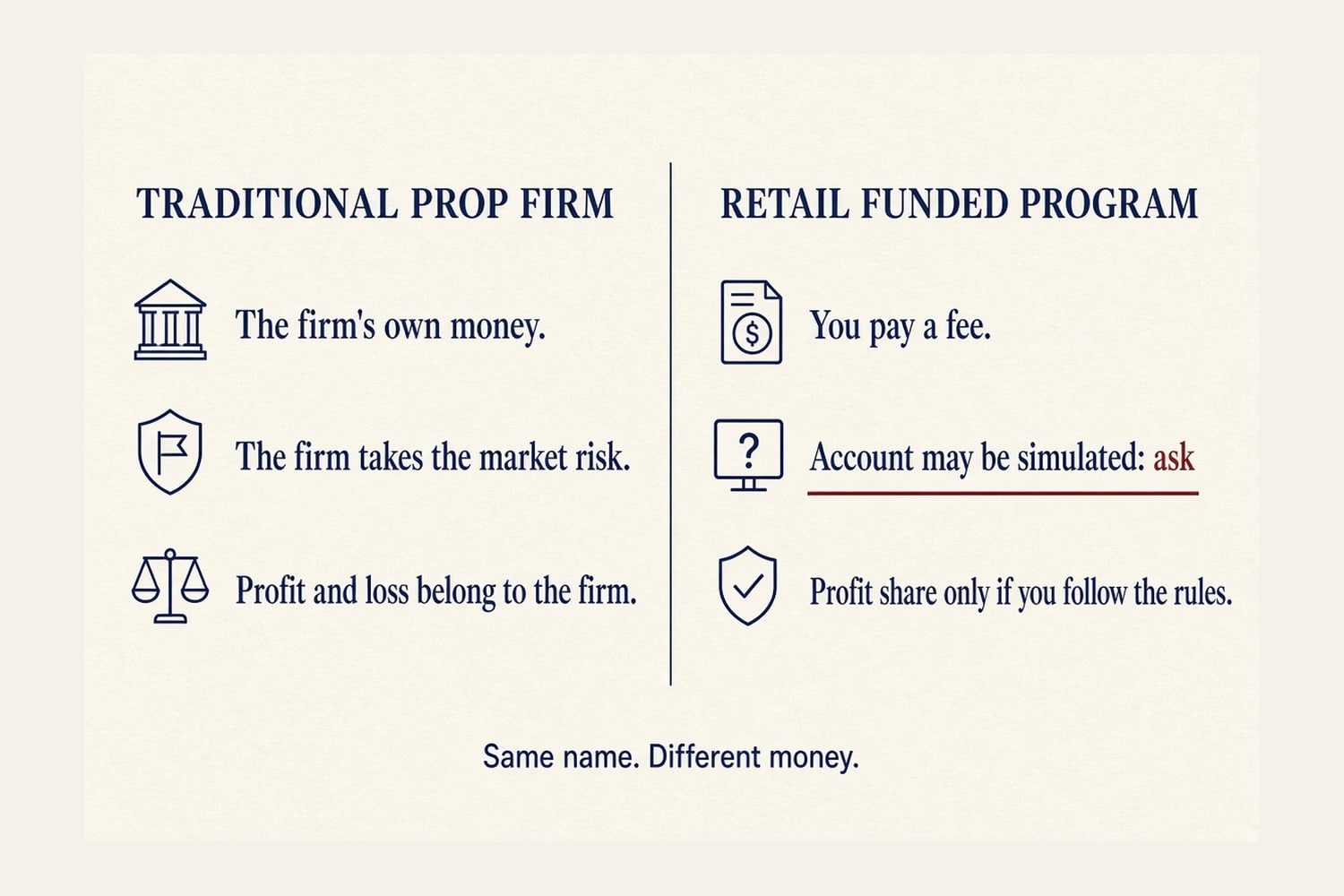
A retail funded program is different: you pay a fee, follow rules, and share profit if you qualify.
Some funded accounts are simulated, meaning practice accounts running on live prices, so always ask what the account really is.
The three main models are one step, two step and instant funding. They move the pressure, they do not remove it.
Crypto suits the model because it trades around the clock and moves a lot, but those same traits make loss limits easy to hit.
From my desk
I read the rules before the account size: loss limits, payout terms, and whether the account is simulated.
Prop trading taught me pure execution without risking my own capital. With my own money I invest about 80% and trade around 20%. A $100,000 funded account is different: risk follows the size and the drawdown rules. It took a few losing accounts to adjust. In the last Mubite tournament I finished in the top 30 out of more than 450 traders, without trading full time. For crypto day traders it fits well, with a platform close to a Binance style interface. My real accounts are on my live accounts page.
What is prop trading, and where does it come from?
Prop trading is trading for the firm's own profit and loss, rather than on behalf of a client for a commission or a fee. That is how the U.S. Congressional Research Service describes the idea in plain terms.
The roots are old. In the Chicago futures pits, floor traders dealt exclusively for their own accounts and did not handle customer orders, as a 1989 report from the U.S. General Accounting Office explains. Brokers executed client orders. Floor traders risked their own capital. That is the original spirit of prop trading: your own risk, your own profit and loss.
Big banks ran prop desks too. The Congressional Research Service notes that in the run up to the 2008 financial crisis, banks took on excessive risks, including through proprietary trading in complex derivatives. Afterwards, U.S. lawmakers decided that banks backed by deposit insurance should not speculate with their own books. The Volcker Rule, part of Section 619 of the Dodd-Frank Act of 2010 and put into practice by five regulators in 2013, generally bans banks from proprietary trading, with exceptions such as market making and hedging.
Then came a third thing. More recently, online firms have sold evaluations to retail traders: you pay a fee, you trade under rules, and you can earn a share of profit. It looks like the old world, but the money and the risks are not the same.
Old prop desks vs retail funded programs: same idea, different money and risks.
How does a funded trader program work today?
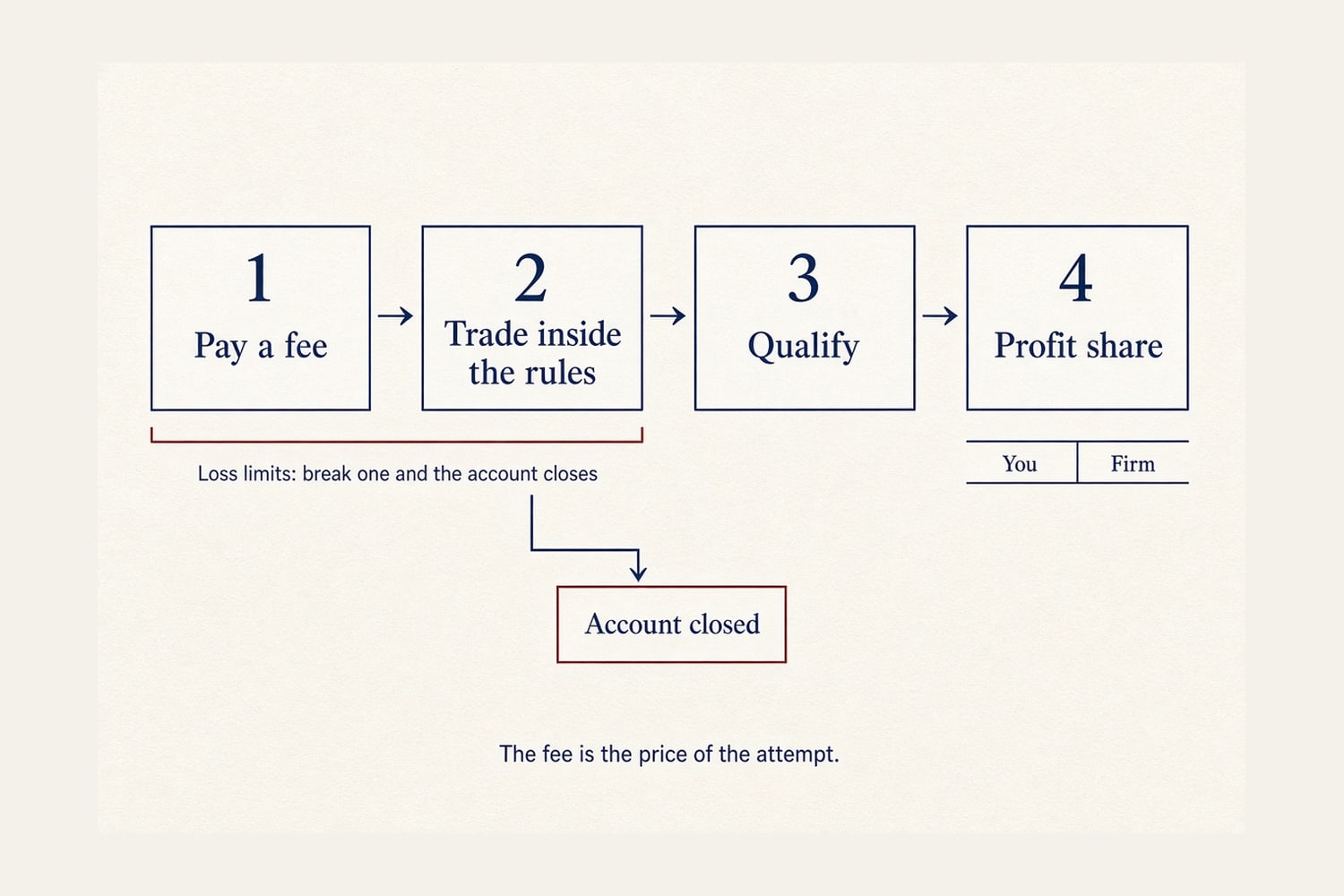
The retail version works in four steps. You choose an account size and pay a fee. You trade inside the firm's rules. If you qualify, the firm shares profit with you. If you break a rule, the account closes.
Two words you need here. A profit split is the percentage of eligible profit that goes to you. Take a simple example with round numbers: on an 80% split, $1,000 of eligible profit means $800 for you and $200 for the firm. A drawdown is the distance your account has dropped below a reference level, and every program sets a limit on it.
The key question is what the account is. At the time of writing, Mubite's own website says its accounts are simulated demo accounts running on live market data, while payouts are paid in real money. Other firms work differently, and some route trades to real markets. The word "funded" does not tell you which. I always ask.
How a funded program works in 4 steps: the fee is the price of the attempt.
Which prop firm models exist, and how do they compare?
Most retail programs fall into three families. Here is the side by side view.
One step: one evaluation with one profit target. Pressure sits before the funded stage. Main catch: a single target with strict loss limits.
Two step: two evaluation phases, each with its own target and loss limits. Pressure is spread over two phases. Main catch: takes longer and costs patience.
Instant funding: funded account right away, no target. Pressure starts from your first trade. Main catch: little room for early mistakes.
Payout rules. The split is only the headline. Look at when you can first withdraw, how often after that, whether each withdrawal is capped, and whether the firm asks for consistency, which means no single day can make up most of your profit.
Drawdown type. A static limit never moves. A trailing limit climbs with your best equity so far. Equity means your balance plus the result of open trades. Example with round numbers, not any firm's rule: a $50,000 account with a $3,000 loss buffer. Static: the floor stays at $47,000. Trailing: you climb to $52,000, so the floor rises to $49,000. Your room to lose shrinks from $5,000 to $3,000 even though you are richer. Same buffer, less room. That is why I check the drawdown type before any other number.
One more split worth knowing: crypto firms and futures or forex firms are not the same. Traditionally, U.S. futures have traded on weekdays, many for roughly 23 hours a day, and not on weekends, according to staff of the U.S. Commodity Futures Trading Commission (CFTC), although some now offer 24/7 access. Crypto platforms run continuously, which changes how you plan your week.
What are the real advantages?
I see four, and I try to be honest about each.
Lower personal risk. In a fee based program, the most you put in is the fee, plus any reset or new evaluation you buy later. Your savings stay out of it.
Bigger size to practise on. A larger account lets you trade your plan at a scale you may not afford yourself. That is a chance to learn, not a promise of profit.
Rules that force discipline. A hard loss limit is a risk manager that never gets tired. It is hard to build one yourself.
A clear path to a payout. The rules are written down. If you meet them, the profit share follows written terms.
None of these is a guarantee. They are tools. A tool used badly still loses.
What are the real risks nobody should skip?
This is the part many ads leave out.
You can lose the fee fast. Most of the risk is the fee and the speed at which a strict loss limit can end an account. Day trading is described as extremely risky by the U.S. Securities and Exchange Commission (SEC), which warns of substantial losses in a very short period.
The account may not be what you think. "Funded" can mean a simulated account. It is not hidden if the firm says so clearly, but it changes what you are buying. You are buying a chance to earn a share of profit under rules, not a brokerage account holding someone's cash.
The firm itself is a risk. In August 2023 the CFTC sued Traders Global Group, which traded as My Forex Funds. Its complaint alleged that more than 135,000 customers had paid at least $310 million in fees, and that the firm used drawdown limits as a pretext to close accounts. These were allegations. In May 2025 a federal judge dismissed the case with prejudice and sanctioned the agency over its conduct in the case. I do not take a side. The lesson is practical: rules, ownership and regulatory status deserve a few minutes of your time.
Leverage cuts both ways. Leverage means controlling a larger position with a smaller amount of money. The CFTC warns that it amplifies risk and that, in margined products, you may lose more than you first put in.
Your own behaviour is the biggest risk. Revenge trading, oversizing after a win, and trading to hit a target are all common. Read my notes on common trading mistakes, and if you are new, start with the free beginner course before you pay for anything.
Even Mubite's site says the payout figures it shows are individual results and not typical. I like that line. Keep it in mind with every payout screenshot you see, from any firm.
Why does the model fit crypto, and why do I use Mubite?
Crypto fits for three reasons, with limits.
It never closes. CFTC staff note that crypto derivatives may be well suited to 24/7 trading because of their digital infrastructure and global reach. You can trade when your day job allows. The same staff warn that round the clock trading could bring reduced liquidity, increased volatility and wider spreads. A spread is the gap between the buying and selling price.
It moves a lot. FINRA, the Financial Industry Regulatory Authority, says crypto assets have shown higher volatility than traditional investments. Big moves can help a profit target and wreck a loss limit in the same hour.
It is digital end to end. Prices, platforms and payments are all online, which helps firms reach traders in many countries. Some countries are restricted, so check yours.
Now Mubite. I picked it because the model matches how I trade, and because the facts below are on its public pages. Check them again before you buy, because firms change rules.
Programs: One Step, Two Step and Instant Funding.
Trading: simulated accounts on live crypto prices from Bybit or Cleo, using contracts quoted in USDT. USDT, or Tether, is a stablecoin meant to track the U.S. dollar. A perpetual contract is a futures style contract with no expiry date.
Trading period: stated as unlimited, so there is no time pressure on a target.
Payouts: a real money profit share, which Mubite states as 70% to 90% of eligible simulated profits depending on the challenge type and add ons. At the time of writing the payout options listed in its FAQ are USDC (another dollar linked stablecoin) on Ethereum, bank transfer, or Mubite Points, not USDT. Identity verification happens before withdrawal.
The accounts are simulated. I say that clearly because it should be clear to you too.
I would rather you know all of that than be surprised later.
What is my checklist before I pay any firm?
Write the answers down. If you cannot answer one, wait.
Who owns the firm, in which country, and how do I contact it?
Does it say plainly whether accounts are simulated or live?
Are the full rules public before checkout?
Is drawdown fixed or trailing, and when does the daily limit reset?
What are the payout rules: first withdrawal, cooldown, caps per request, consistency?
What verification do I need before a payout?
What is the total cost, including resets and add ons, and what is refundable?
Is the marketing pushing me with deadlines or promises of easy money? The CFTC lists both as warning signs.
Can I explain in one sentence how this firm earns money?
FAQ
What is prop trading in simple words?
It is trading with a firm's own money for the firm's own profit and loss. In the retail version, you pay a fee to trade under a firm's rules and can earn a share of profit if you qualify.
Is a funded account real money?
Not always. Some programs use simulated accounts on live prices and pay real money from the firm's side. Read how the firm describes its accounts, and ask support if it is unclear.
Can I lose more than the fee?
Check the firm's terms. In a fee based program your cost is the fee plus anything extra you buy, such as resets.
What is the difference between one step and two step?
Two step has two evaluation phases. One step has a single phase. Neither removes the loss limits.
Are prop firms legal and safe?
It depends on the firm, so there is no blanket answer. Check ownership, location, public rules and payout terms, and never pay money you cannot afford to lose.
The challenge I use to test my rules
Mubite is where I run my funded accounts. Sign up through my link and enter the code CRYPTOJOBS.