Spot vs futures trading explained simply: do you own the coin or a contract? Learn how crypto futures differ from spot, and where a beginner should start.
Spot vs futures trading: do you own the coin, or a contract? On spot, you buy the coin and it is yours. On futures, you trade a contract that follows the price, usually with leverage. Here is the difference, and where a beginner should start.
Spot vs futures at a glance
Key takeaways
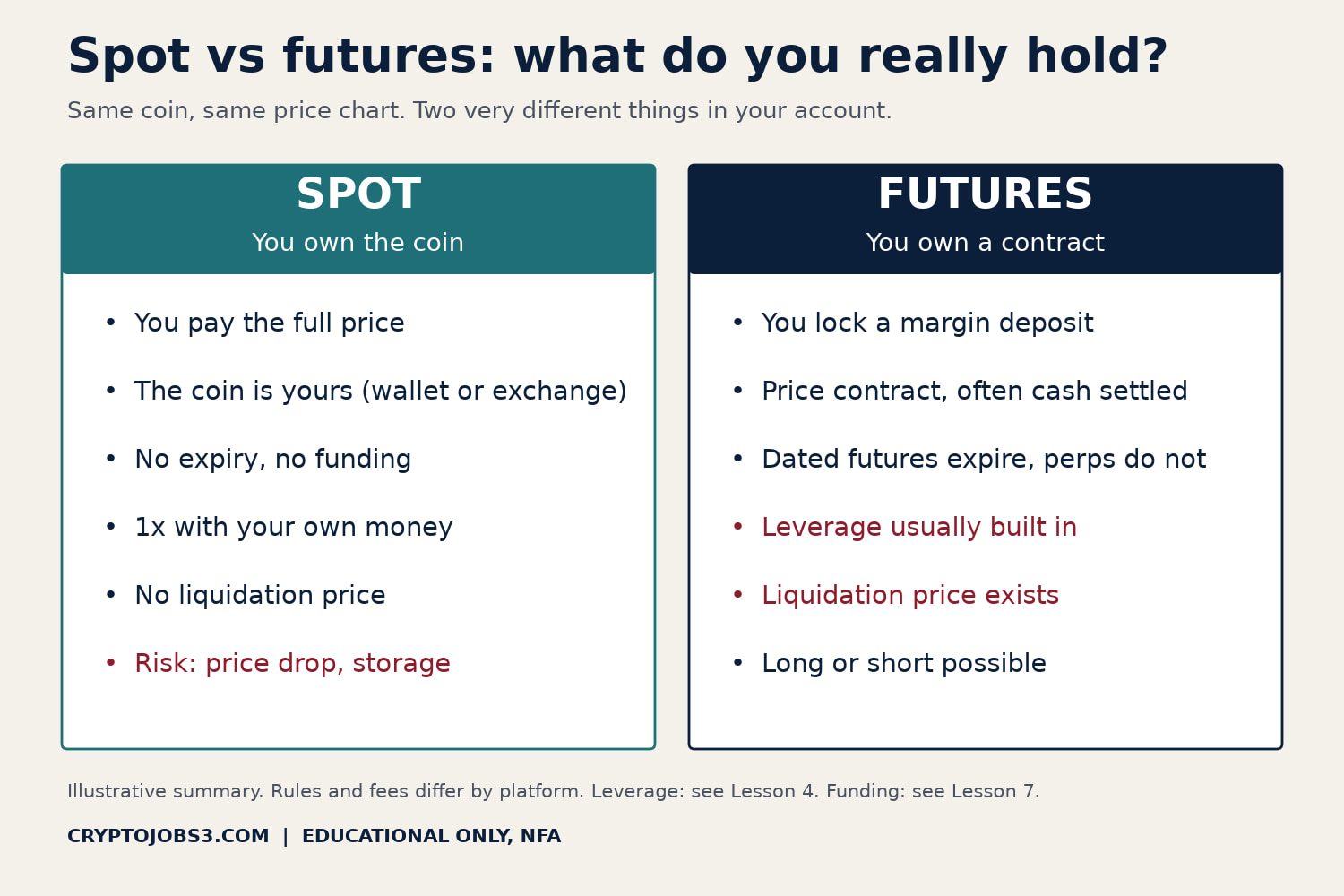
Spot means you buy the coin and pay now. The coin is yours.
Futures means you trade a contract based on the price. Many crypto futures are settled in cash, so you never receive the coin.
Classic futures have an expiry date. Perpetual futures, or perps, have none.
Leverage lives on the futures side. On spot with your own money, there is no liquidation price.
What is spot trading in crypto?
The US futures regulator, the Commodity Futures Trading Commission (CFTC), describes spot as a market of immediate delivery and payment.
Owning the coin brings one job: keeping it safe. The SEC, short for the US Securities and Exchange Commission, explains that losing your private key means losing your coins for good. If the exchange or provider holding them is hacked, closes, or goes bankrupt, you could lose access too.
What is futures trading in crypto?
A futures contract is an agreement about a price, settled later. Usually you are not buying Bitcoin, you are trading its price.
You may never touch the coin. The CFTC warns that with many crypto futures you may not be entitled to the actual coin. These contracts are "cash settled": one side pays the other the cash value.
You post margin, not the full price.Margin is a deposit, and the CFTC says it is not a partial payment for the coin. Because you fund only a fraction of the position, leverage appears. See Lesson 4.
How do spot and futures differ on the same price move?
Round example numbers, fees left out. Bitcoin (BTC) is at $100,000.
Spot: you spend $1,000 and hold 0.01 BTC. If BTC rises to $110,000, your coins are worth $1,100. If it falls to $90,000, they are worth $900. Nothing forces you to sell.
Futures: you buy a cash settled contract on 0.01 BTC at $100,000. That is a long, explained in Lesson 2: Long vs Short. If BTC rises to $110,000, you receive $100 in cash. If it falls to $90,000, you pay $100 in cash. You never hold a coin.
Do crypto futures expire?
Classic futures have a fixed expiry date, and near it the contract price lines up with the market price. To stay in, you close and open the next one, called rolling.
Perpetual futures have no fixed end date. Researchers call perps the most popular crypto derivative. To keep the perp price close to spot, longs and shorts pay each other a funding rate, see Lesson 7.
Should a beginner trade spot or futures?
Start on spot. Without any borrowing, a price drop alone does not force you to sell. Futures are a normal tool, but the CFTC calls speculating here high risk and says to risk only money you can afford to lose.
Checklist before your first futures trade
Can you explain the contract? Dated or perpetual, and how it settles.
Do you know your margin? Check where liquidation sits too, see Lesson 6.
Do you know the funding cost of a perp? See Lesson 7.
Is your leverage low? Start small, and see Lesson 4.
Is it money you can afford to lose? If not, stay on spot.
FAQ
What is the main difference between spot and futures?
On spot, you own the coin. On futures, you hold a contract on its price.
Is spot trading safer than futures?
For a beginner, usually. Spot without borrowing has no liquidation price, but it still carries price risk.
Do you own the crypto when you trade futures?
Often not. Many crypto futures are cash settled, so you never receive the coin.
Do perpetual futures expire?
No. Perps have no fixed end date, but longs and shorts pay funding to each other.