Leverage trading explained with a real case: $1,000 at 20x, profit and loss on a 1% move, Bybit fees, and how to calculate your liquidation price.
You put $1,000 on the table, move the slider to 20x, and the app shows a $20,000 position. Nice? Maybe. A 1% move now hits you like 20%. Let's walk through this exact trade with real exchange fees.
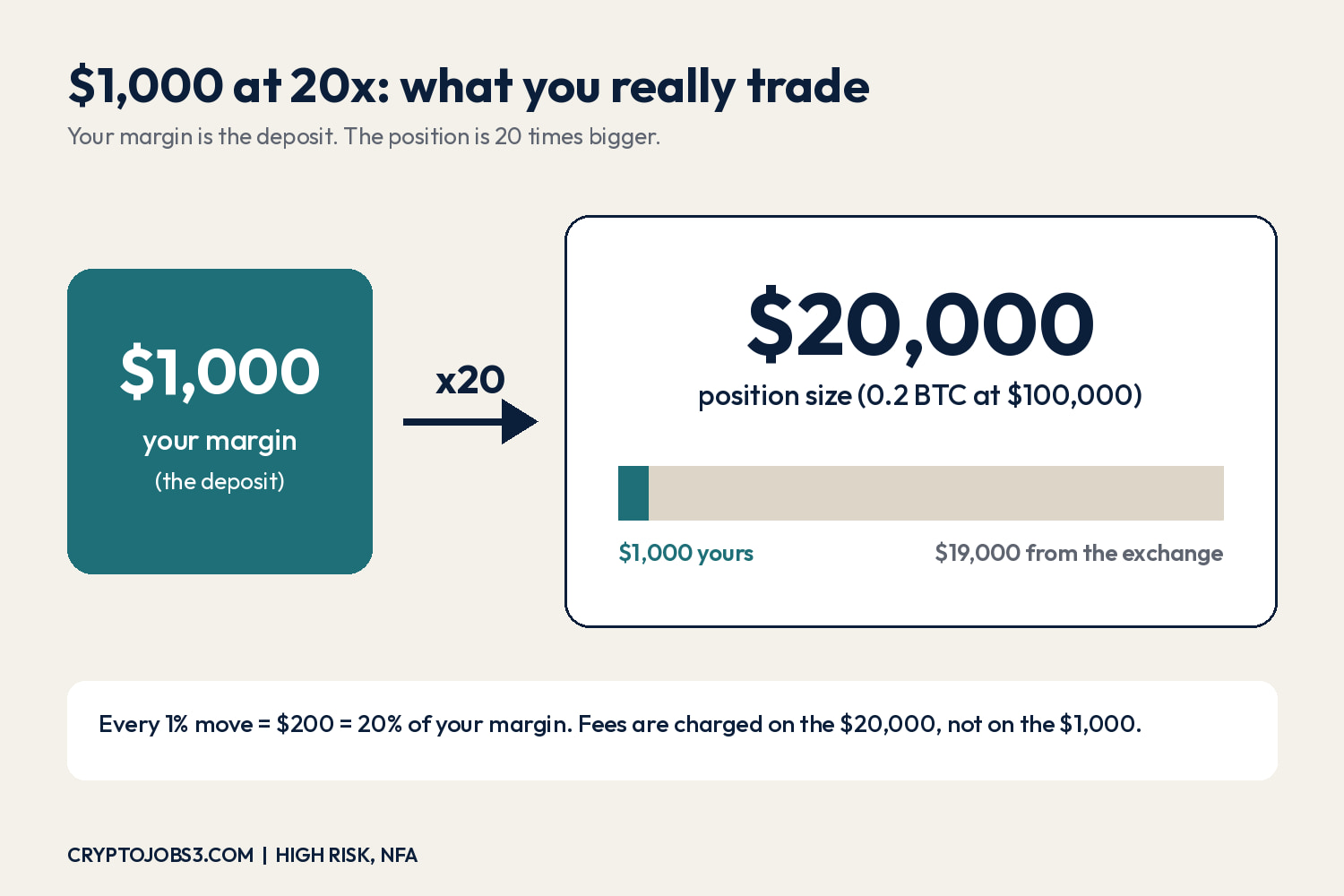
$1,000 at 20x: what you really trade
Key takeaways
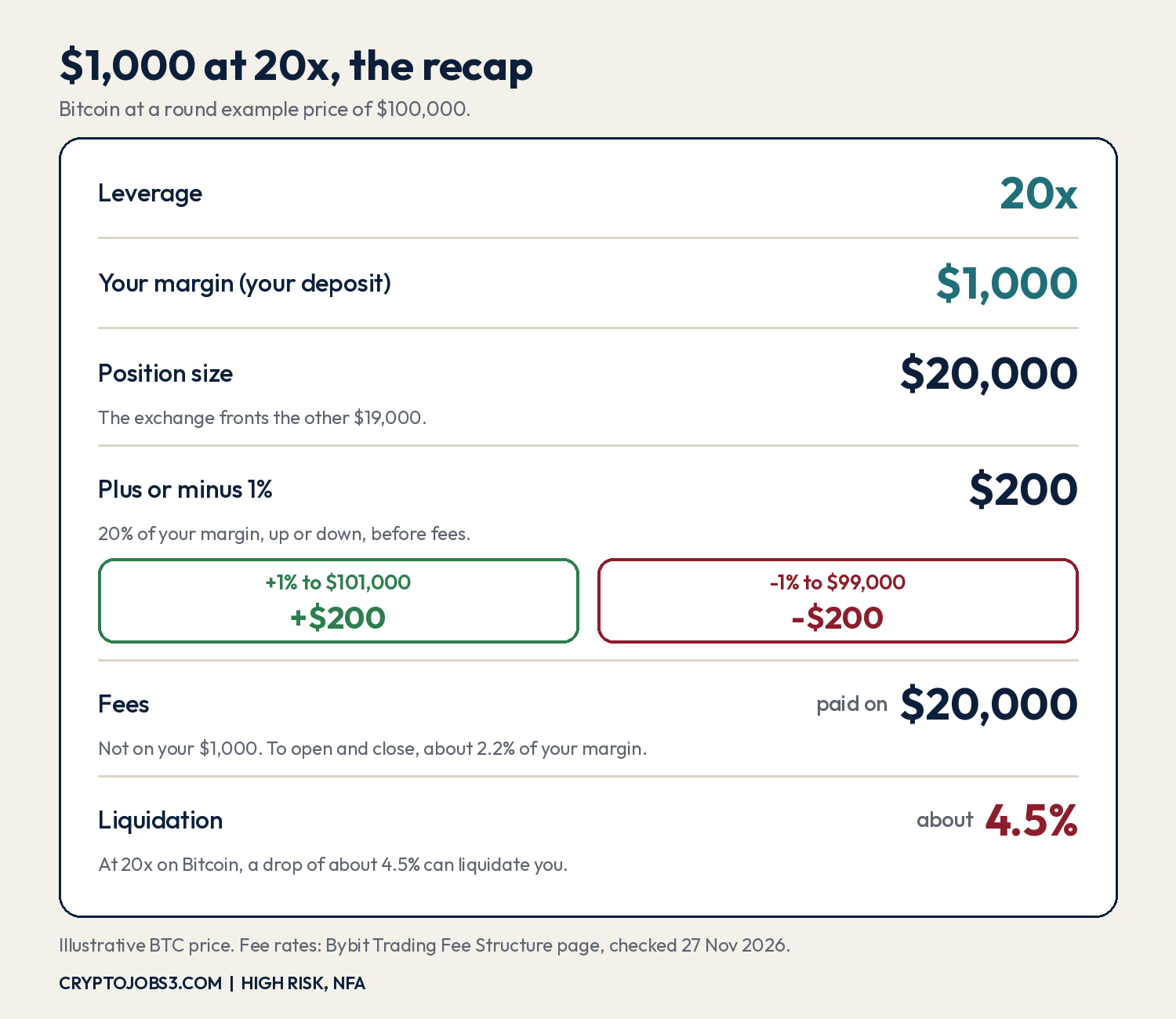
At 20x, $1,000 of margin opens a $20,000 position. The exchange fronts the other $19,000.
A 1% move is worth $200: 20% of your margin, up or down.
Fees are charged on the full $20,000, not on your $1,000. A round trip costs about 2.2% of your margin.
At 20x on Bitcoin, a drop of about 4.5% can liquidate you.
$1,000 at 20x, the recap
How big is the position with $1,000 at 20x?
Leverage is a multiplier. Position size equals margin times leverage: $1,000 x 20 = $20,000. Think of margin as a deposit at the counter, not the price of what you buy.
With Bitcoin, or BTC, at a round example price of $100,000, your $20,000 controls 0.2 BTC. You are a buyer, so this is a long: you win if the price rises.
What happens if the price moves 1%?
Every 1% on $20,000 is $200. Before fees:
BTC rises 1% to $101,000: +$200, or +20% on your $1,000.
BTC falls 1% to $99,000: minus $200, or minus 20% on your $1,000. Your margin drops to $800.
Tiny on the chart, big in your account. Same logic for a short, just in the other direction.
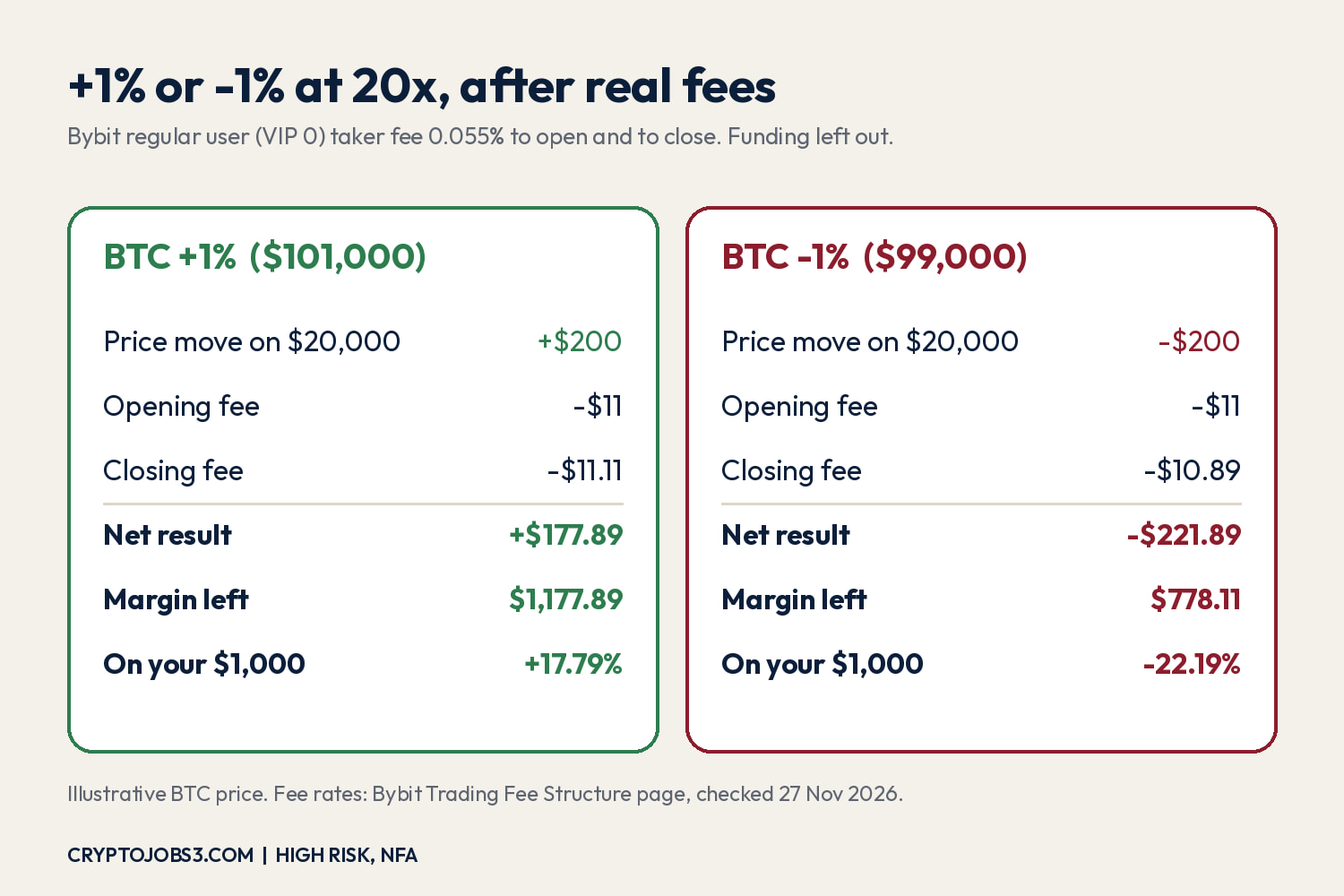
+1% or -1% at 20x, after real fees
How much do opening and closing fees cost?
Bybit's official fee page, regular user level VIP 0, checked 27 Nov 2026, and expiry contracts:
Taker fee, when your order fills right away at market: 0.055%.
Maker fee, when your limit order waits in the order book: 0.02%.
Bybit charges it on the position value. As a taker, you pay twice:
Opening fee: $20,000 x 0.055% = $11.
Closing fee after +1%: $20,200 x 0.055% = $11.11. Net result: +$177.89, so +17.79% instead of +20%.
Closing fee after minus 1%: $19,800 x 0.055% = $10.89. Net result: minus $221.89. Your $1,000 is now $778.11.
With maker orders on both sides, fees fall to about $8 per round trip. Funding payments on perpetual contracts come on top, see Lesson 7.
How do you calculate the liquidation price?
This is still the same example: $1,000 of margin at 20x opens a $20,000 position, and Bitcoin is at the round example price of $100,000.
The exchange wants a minimum left in the position: the maintenance margin. Bybit sets it at 0.5% of the position value for a BTCUSDT position up to 2,000,000 USDT. If losses eat your margin down to it, you are liquidated.
Simplified formula for a long, fees and tiers left out:
Liquidation price = entry x (1 minus 1/leverage + maintenance margin rate)
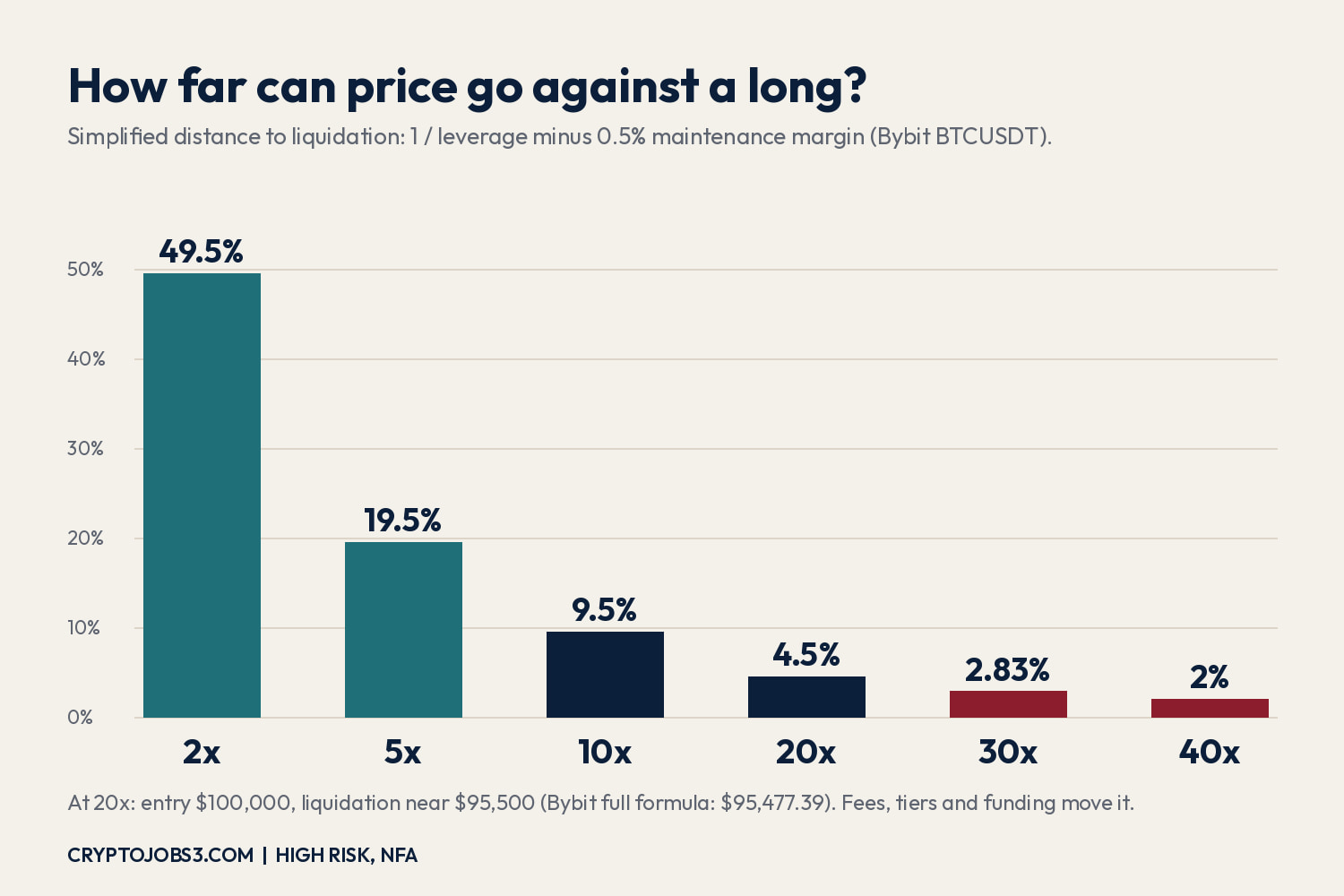
$100,000 x (1 minus 0.05 + 0.005) = $95,500, about 4.5% below entry.
For a short: $100,000 x (1 + 0.05 minus 0.005) = $104,500.
Bybit's full formula gives $95,477.39 for this long: close, not exact. Always read the number your exchange shows. Lesson 6 goes deeper.
What do you really lose? About $900 of price loss at that level, and Bybit then closes the position at the bankruptcy price. Plan on losing the whole $1,000, plus the $11 opening fee.
More leverage, less room to be wrong
Which leverage fits which pair?
It depends on the pair. On top pairs with lower volatility, leverage can go up to 30x to 40x. On more volatile tokens, go lower: a normal daily swing can reach your liquidation price. At 40x, the simplified distance is only 2%.
Checklist before a leveraged trade
Position size: margin x leverage. Do you know it?
Value of 1%: in dollars and in % of your margin.
Fees: both sides, on the full position.
Liquidation price: read on the exchange, far from normal swings.
Leverage vs pair: lower on volatile tokens.
FAQ
Does 20x leverage mean 20 times more profit?
On the price move, yes. Losses grow just as fast.
Are fees calculated on my margin or on the position?
On the position. A 0.055% fee on $20,000 is $11, that is 1.1% of your $1,000 margin.
Can I lose more than my margin?
In isolated mode, the loss is meant to stay inside that position's margin: Bybit says each position has its own margin, and liquidating one does not affect the others. Cross mode works differently, see Lesson 6.