Market vs limit orders: do you want to buy right now, or only at your price? A market order fills at once at the best price on offer. A limit order waits for your price. Here is how each works, and what maker and taker mean.
Key takeaways
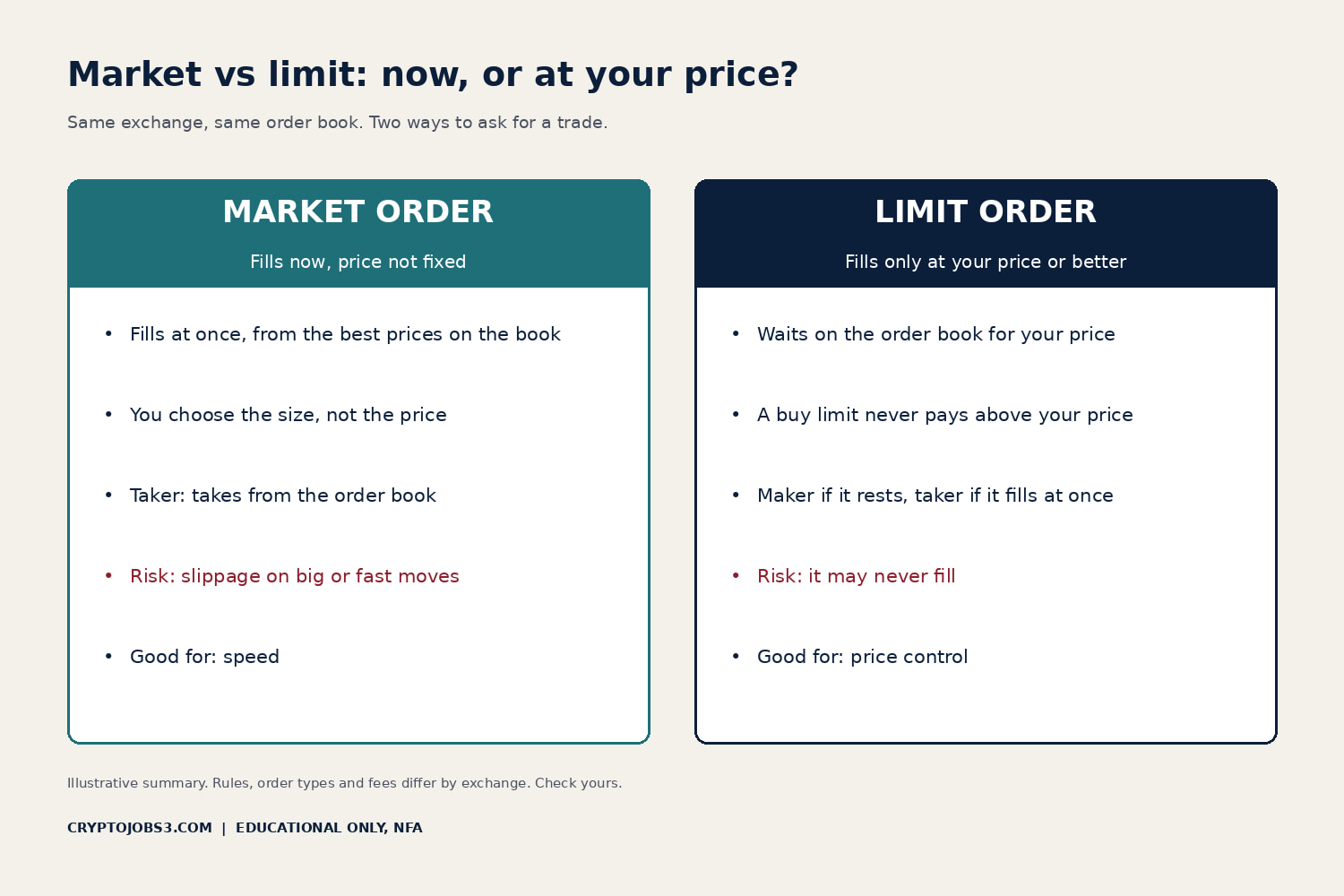
- Market order: fills right away at the best available price. The final price is not guaranteed.
- Limit order: fills only at your price or better. It may not fill at all.
- A market order can suffer slippage, the gap between the price you expected and the price you got.
- On many exchanges, a market order is a taker and a limit order resting on the book is a maker. The two can pay different fees.
What is an order book?
An order book is the live list of buy and sell limit orders still waiting to be filled, as Kraken's trading glossary puts it. Buyers wait with the price they will pay, sellers with the price they ask. The exchange fills market orders from the best prices at the front.
What is a market order?
The US Securities and Exchange Commission, or SEC, says a market order buys or sells at the best available price and is generally executed immediately. The price is not guaranteed, and you may not get the last traded price.
What is a limit order?
You choose the price. A buy limit fills only at your price or lower. A sell limit fills only at your price or higher. The SEC adds the trade-off: a limit order is not guaranteed to execute, because the market must reach your price.
What are maker and taker fees?
Kraken, an exchange, explains: a maker order is not matched immediately and sits on the order book; a taker order is matched at once against an order already there.
- All market orders are takers.
- A limit order can be a taker too. A buy limit priced above the best sell offer fills at once.
Fee rates differ by exchange, so check yours.
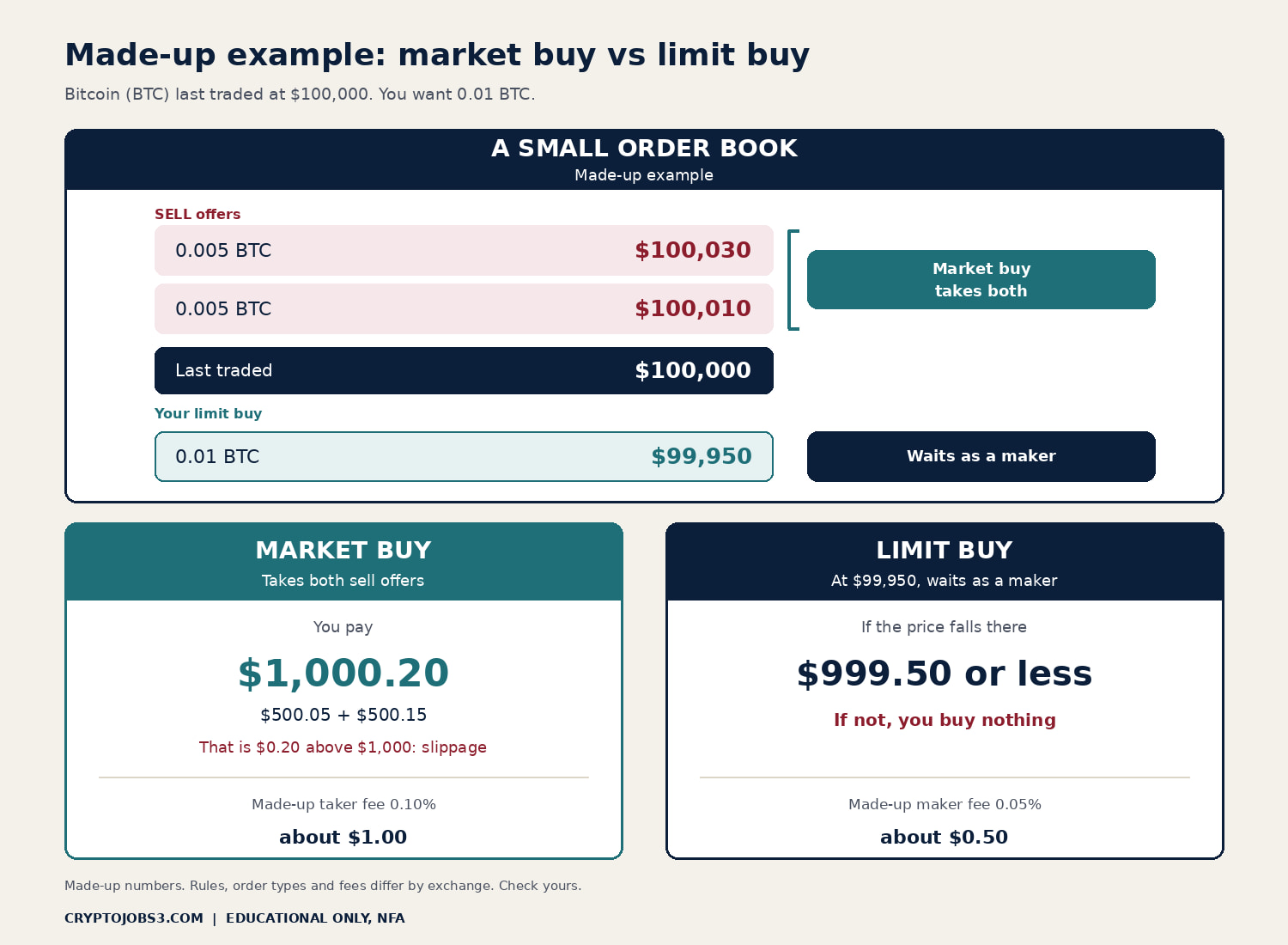
How does a market order compare with a limit order in a small example?
Made-up example numbers. Bitcoin (BTC) last traded at $100,000. The best sell offers are 0.005 BTC at $100,010, then 0.005 BTC at $100,030. You want 0.01 BTC.